
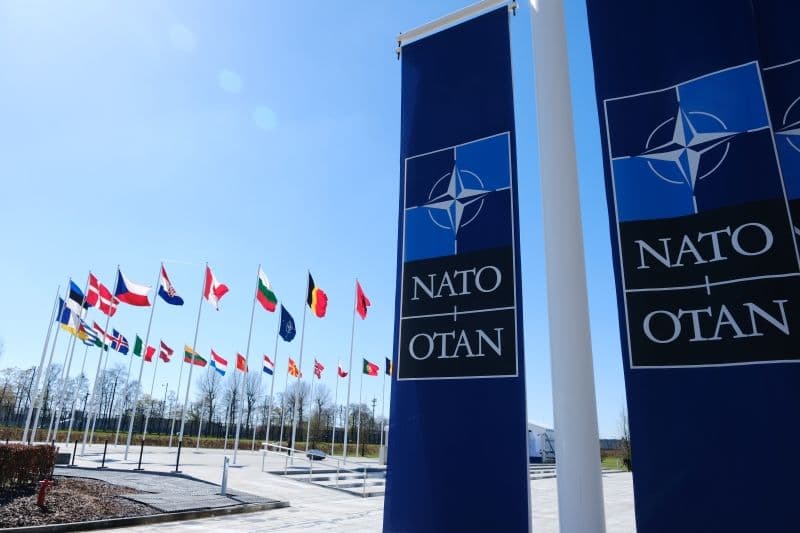
Member states flags flying outside the NATO headquarters in Brussels. (Alexandros Michailidis/Shutterstock.com)
NATO opens EUR9m procurement for tactical satellite radios
The solution must include power supplies, matrix switches, and power amplifiers, among other things.
10 NOV 2025

By
George
Fitzmaurice
Defence Reporter, Clarion Defence & Security
NATO is calling on industry to support the setup and installation of its new generation ultra-high frequency (UHF) tactical satellite radios following a notice published by the authority on 6 November.
The authority invites companies to bid for a contract valued at EUR9 million, which forms part of a wider procurement project involving the acquisition of new generation UHF radios for on-the-pause, on-the-move and deployable headquarters operations.
Specifically for this contract, NATO requires the “design, procurement, installation, and testing of the static site equipment such as static antenna, matrix, and ancillaries for NATO static sites”.
The chosen contractor will be “responsible for delivering the complete and fully integrated UHF communication” supportive infrastructure with required functionality and performance, NATO said.
Detailing its general requirements under this contract, NATO said the UHF system must include fixed site UHF antennas, power supplies, matrix switches, cables, power amplifiers, loudspeakers, carry cases and mounting kits to support static installations.
The system must also work as a stand-alone piece of equipment and must only connect to other UHF tactical satellite terminals over satellite communication and line-of-sight services.
Some of the more technical requirements include that “Each terminal (and subsequently the equipment chain) shall be able to receive and transmit one half-duplex UHF channel simultaneously” and support the routing of any radio channel to any antenna.
The UHF radios must be equipped with a cryptographic device to secure transmissions between user terminals and the control station, as well as be designed to allow a future upgrade of cryptographic algorithms.
The notice closes on 5 December, with a contract award date anticipated for Q3 2026.
George
Fitzmaurice
Defence Reporter, Clarion Defence & Security
George Fitzmaurice is a UK-based defence reporter at Clarion Defence and Security. He previously worked as a reporter for tech publication ITPro and as an intern at the New Statesman.