
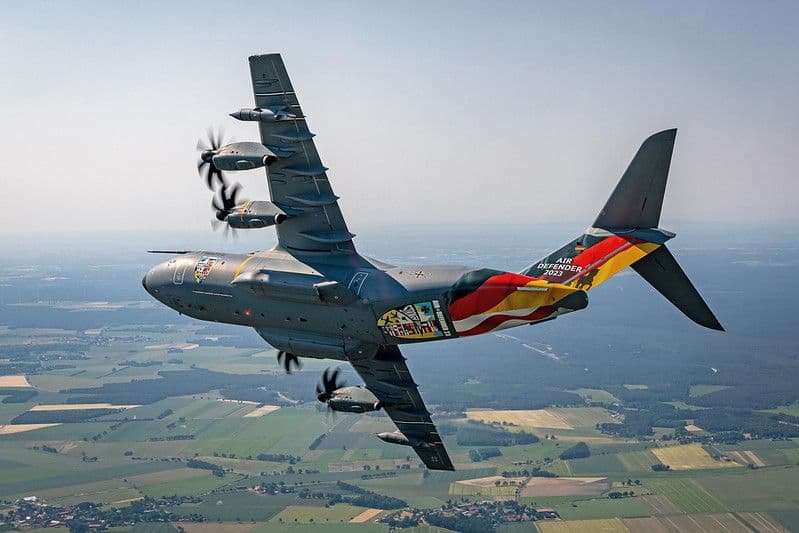
German Chancellor-elect Friedrich Merz wins the election. Pictured is the German Airbus A400M transport aircraft. (Bundeswehr/Patrik Bransmöller)
The end nears for Germany’s ‘special defence fund’. New Chancellor, new investment?
Radical defence investment and SME integration has topped the political agenda in Germany since Friedrich Merz won the 23 February elections.
25 FEB 2025
As Germans across the country return from voting for their new Chancellor on 23 February, a ‘day after’ plan for the looming end of the government’s special defence fund remains front and centre for the German – and European – defence industry.
Previous German Chancellor Olaf Scholz earmarked EUR100 billion for this ‘special fund’, or ‘Sondervermögen’, shortly after Russia’s full-scale invasion of Ukraine in 2022, amid ongoing accusations of Germany as a NATO spending laggard.
The Sondervermögen will run out at the end of 2026, however, with no clear strategy to replace it. As Chancellor-elect Friedrich Merz and other party leaders thresh out the composition of the new German government, defence has received a level of attention unprecedented in modern German history.
Whatever the makeup of the new administration, it will almost certainly increase Germany’s defence expenditure in line with NATO demands, according to Dr. Hans Christoph Atzpodien, Managing Director of the Federation of German Security and Defence Industries (BDSV).
“Defence spending will undoubtedly be adjusted by the next federal government in order to meet NATO’s rising requirements, which may be equivalent to at least 3% of our GDP”, Atzpodien told DSEI ahead of the election. “We expect this to happen independent of any future government’s party-composition.”
Such a pro-defence political landscape breaks with a long-held taboo around military spending in Germany, held since the Second World War.
Chancellor-elect Merz looks to “drone procurement” and “young generals”
Merz and his Christian Democratic Union (CDU) party won 28.6% of the vote in the federal elections, although this is not enough for an outright majority.
The far-right Alternative for Germany (AfD) party doubled its vote share to 20.8% in second place, followed by Olaf Scholz’ Social Democratic Party (SDP) with 16.4% in third.
Merz has confirmed he will push for a centrist coalition with the SDP rather than working alongside the AfD, which has not specified defence policies aside from reinstating compulsory military service.
Defence was a cornerstone of Merz’ election speech on 24 February, in which he said his “absolute priority will be to strengthen Europe as quickly as possible so that, step by step, we can really achieve independence from the USA”.
He warned that “this is really five minutes to midnight for Europe”, speculating “whether we will still be talking about NATO in its current form or whether we will have to establish an independent European defence capability much more quickly” before the NATO summit in June.
Before the election, Merz rejected US President Donald Trump’s calls for NATO members to spend 5% of GDP on defence – which included a direct jab at Germany. Nonetheless, he has consistently promised to increase defence expenditure. In a televised debate on 9 February, Merz floated the possibility of loosening Germany’s debt limit to finance this push “towards 3%” of GDP.
Now as Chancellor-elect, Merz has suggested he could work with mainstream parties to loosen the country’s debt brake before the 25 March deadline to form a new coalition government. He has already begun talks with the SDP over an emergency EUR200 billion defence fund, Bloomberg reported, moving hastily against a potential block on debt-brake reform by fringe parties.
A spending boost was backed up by Stefan Thumann, CEO of German small and medium-sized enterprise (SME) Donaustahl, who is involved with Merz’ election team on matters of economy, procurement, and foreign security.
“The next [CDU] federal budget plans to contain EUR300 million for drones and procurement of new defence technology”, Thumann told DSEI.
No specifics were offered on the type of defence technology, but Thumann added that “Merz will appoint a younger generation of generals more comfortable with new technology”.
Thumann’s remarks and Merz’ emergency defence fund provide some reassurance for a defence industry concerned about what happens when the Sondervermögen runs out.
Nearly EUR30 billion in funding from the Sondervermögen maintains several ongoing German defence programmes, namely the Poseidon reconnaissance and anti-submarine warfare system, F-35 Lightning II fighter aircraft, and STH heavy-lift helicopter.